Community Development
What Is Community Development?
A plain definition of community development: who does it, what it funds, how it differs from charity, and why it pairs housing with local power.
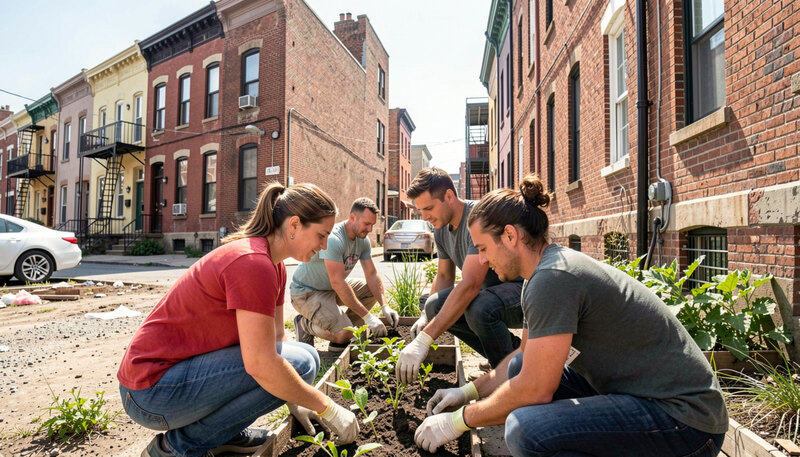
Community development is the work of improving a place's economic and physical life with its residents, not just for them. In the United States the term carries a specific professional meaning: a field of nonprofits, public agencies, community lenders and organizers that rebuilds housing, businesses and services in low-income neighborhoods. This guide defines the field plainly, explains where it came from, what it actually does, and how it differs from charity and from ordinary real estate development.
What does community development mean in practice?
At street level, community development is a set of concrete activities: building and renovating affordable housing, financing small businesses and community facilities, creating jobs and job training, organizing residents around the decisions that affect their block. What unites the activities is intent and method. The intent is the health of a defined community, usually a low-income neighborhood or a population the mainstream market underserves. The method puts residents inside the decision rather than outside it: community development corporations are governed by people from the neighborhood they work in, and the field's oldest rule is that nothing about the community should be decided without the community.
Where did the field come from?
The modern American field grew from the civil rights era and the War on Poverty. The late 1960s brought the first community development corporations, and the following decades built the machinery around them. The Community Reinvestment Act of 1977 pushed regulated banks to serve the neighborhoods they drew deposits from. The Low-Income Housing Tax Credit, created by the Tax Reform Act of 1986, became the largest engine for building affordable homes. The CDFI Fund, established in 1994, certified and capitalized community lenders. Federal block grants through CDBG and HOME gave cities flexible money for housing and neighborhood work. Intermediaries like LISC and Enterprise Community Partners grew into national institutions that channel capital and know-how to local organizations.
Who does the work?
Four kinds of actors dominate the field. Community development corporations and other place-based nonprofits plan and build projects in their own neighborhoods. Community lenders, including the CDFIs described in the CDFI guide, supply the loans and equity the projects need. Public agencies at the federal, state and city level fund, regulate and sometimes deliver the work directly; in Washington DC the Department of Housing and Community Development plays that role. And philanthropy, from large foundations to faith communities, supplies the patient grants and program-related investments that let everything else close. The HUD USER research portal publishes the federal evidence base behind much of this work.
The work is slow by design. A single affordable housing building moves from site control to construction in three to seven years, and neighborhood-scale efforts run a decade or more. Success is measured in units built and preserved, businesses financed, jobs obtained and held, and in whether the residents who started the effort still live in the neighborhood when it succeeds. Because the results arrive slowly, the field also invests in the organizing itself: leadership training, tenant associations and neighborhood planning councils that keep decision power local between projects, not only during them.
How is it different from charity?
Charity relieves need; community development builds capacity. A food pantry feeds a family tonight; a community development project finances the grocery store, the jobs and the housing that change what the family can afford next year. The distinction shows in the money: community development runs on investments expected to come back, not donations spent once. A loan fund recycles repayments into the next project, a tax credit draws private equity into housing, and a community facility generates the revenue to keep itself open. This is also what separates the field from ordinary development: a market developer answers to investors' returns, while a community developer answers to a mission and, usually, to a board drawn from the neighborhood.
What does it look like on a real block?
A typical effort starts with a specific site or problem: a vacant apartment building, a corridor of empty storefronts, a clinic the neighborhood lacks. The community developer assembles the project layer by layer, community input first, then design, then the financing stack described in the nonprofit housing financing guide. The same discipline applies at neighborhood scale: neighborhood revitalization sequences housing, commercial space, services and public realm over years rather than months. In Washington DC the public half of the picture, from the Housing Production Trust Fund to inclusionary zoning, is mapped in the DC programs guide.
Why does the field still matter?
The market left to itself does not build for the lowest incomes, and public subsidy alone has never filled the gap. Community development exists in that space, combining public money, private capital and local knowledge into projects that neither government nor the market produces alone. Its tools, from loan funds to land trusts to tenant purchase rights, are described across the community development section of this site. For readers who want the financial machinery first, the community finance section explains where the money actually comes from.