Affordable Housing
What Is Supportive Housing?
Supportive housing pairs affordable homes with services for people facing disability, illness or homelessness. How it works and how it is funded.
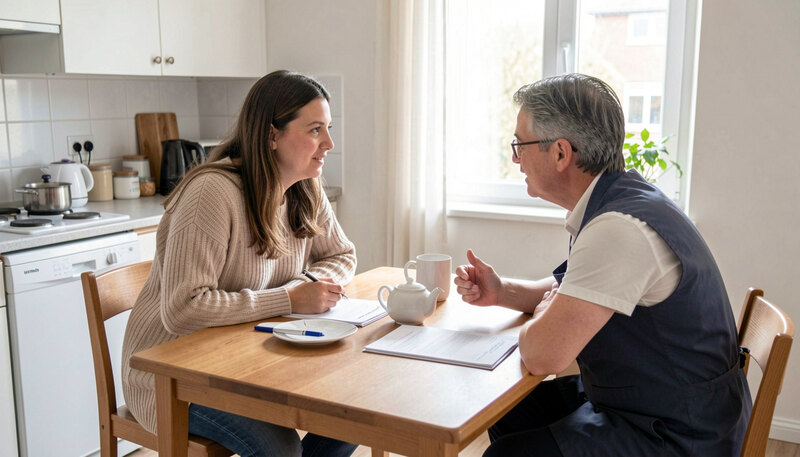
Supportive housing is affordable housing with services attached, built for people whose lives collapse without both. The model houses a person first, then wraps voluntary services around that home: case management, health care, addiction treatment, employment help. It serves people facing chronic homelessness, serious mental illness, disability, chronic illness or captivity in institutions. This guide explains the model, who lives in it, how it differs from shelter and treatment settings, how it is funded, and what the evidence says about whether it works.
What exactly is the model?
Three commitments define supportive housing. The housing is permanent: tenants hold leases with the same rights and obligations as any renter, not beds earned by compliance. The services are voluntary: a tenant cannot be evicted for refusing treatment, and outreach continues after a refusal. The pairing is intentional: property management and services staff work as one team with shared records and shared response when a tenancy wobbles. The Corporation for Supportive Housing, the national intermediary for the field, spreads this definition through its work at csh.org. Break any of the three commitments and the model degrades into something else: a program with rules, or housing with a social worker down the hall and no relationship.
Who lives in supportive housing?
Residents are people for which ordinary affordable housing alone has failed. The largest group is people experiencing chronic homelessness, defined as homeless for a year or repeatedly, with a disabling condition. Others include people with serious mental illness leaving hospitals or at risk of institutionalization, people with HIV or AIDS, veterans with disabilities, young people leaving foster care, and people reentering the community from correctional facilities. In Washington DC the model has deep roots: nonprofit loan funds were financing supportive housing for people with mental illness as early as the 1990s, a history traced in the guide to community finance in Washington DC.
How is it different from shelter?
Shelter is temporary by design: a bed, a curfew, a case manager, and an exit plan. Supportive housing is a home with an address, a lease and no curfew. Shelter rules are collective because the setting is communal; supportive housing rules are the ordinary terms of tenancy. The difference in outcomes follows from the difference in premise: a person in shelter is being processed toward housing, while a person in supportive housing already has it and is being supported to keep it. Transitional programs sit between the two, offering time limited housing with mandatory services, a model that has been shrinking as permanent approaches have proven themselves.
What is Housing First?
Housing First is the philosophy that reordered the field. Its claim: end a person's homelessness first, then treat addiction and illness in the stability of a home, rather than requiring treatment or sobriety as the entrance fee to housing. Pathways to Housing developed the approach in New York in the 1990s, and federal policy adopted it across programs in the 2000s. The evidence, including large multisite federal evaluations, has consistently found high housing retention among Housing First participants and no increase in substance use, findings summarized in the research sections of CSH's library. The older staircase model, which moved people through readiness tiers, keeps housing as a reward; Housing First makes it the platform.
How is supportive housing financed?
Bricks and services are funded separately, and each side has its own ladder. The capital side looks like any nonprofit affordable project: low income housing tax credit equity, state and city trust funds, federal HOME money and loans from community lenders, the stack detailed in how nonprofit housing projects are financed. The services side draws on federal Continuum of Care grants administered by HUD, state mental health and Medicaid funding, veterans programs such as HUD VASH vouchers paired with case management, and local appropriations. The two sides rarely align neatly: capital grants want buildings open, service contracts start late, and operating rents never quite cover the cost of the team. Sponsors close the gap with project based subsidies and fundraising.
Does it work?
The evaluation record is unusually strong for a social program. Multisite studies report the large majority of Housing First tenants still housed a year or more later, against much lower retention for treatment first approaches. Costs shift rather than vanish: hospitalizations, emergency rooms, psychiatric beds, shelters and jails fall, often enough to offset much of the housing cost for the highest users of crisis systems. Permanent supportive housing has reduced chronic homelessness measurably in communities that committed to it. Honest limits remain: employment outcomes improve modestly, some tenants lose housing anyway, and the model only reaches those whom programs admit.
How does supportive housing relate to affordable housing overall?
Supportive housing sits at the deepest end of the affordability ladder, typically renting to households below thirty percent of area median income, often on disability benefits. It is a subset of affordable housing, not a synonym: most affordable units carry no services, as explained in what affordable housing is. The financing world around both is the same community development ecosystem described in the guide to community development: lenders, tax credits and public programs pulling in one direction, a home that holds.